

The Snake That Eats Itself
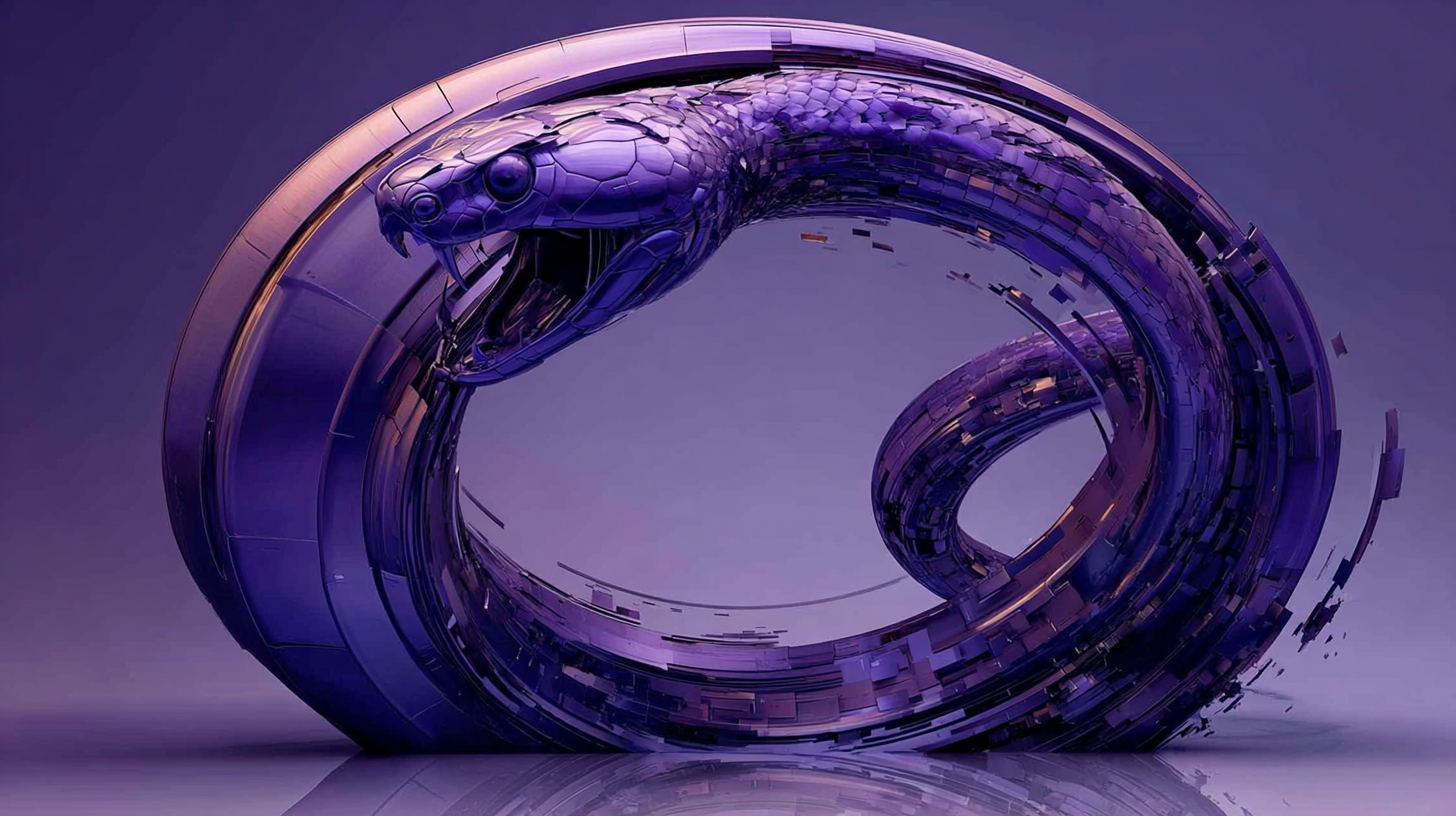
In the race to train smarter models, there's a problem nobody saw coming: the internet is filling up with content that wasn't created by humans.
Photocopies of Photocopies
There's an experiment anyone can do at home. Take a photo, then make a photocopy of it. Then make a photocopy of that photocopy. Repeat the process ten times. What started as a crisp image ends up as an unrecognizable smudge. Each iteration loses information, amplifies errors, and degrades the original signal until nothing useful remains.
This is exactly what is happening to artificial intelligence. In July 2024, a team of researchers from Oxford and Cambridge published a disturbing finding in Nature: when language models are trained on text generated by other language models, they collapse. First, they lose the nuances. the rare expressions, minority perspectives, and extreme cases. Then, generation after generation, they converge towards increasingly homogeneous outputs until they produce nonsense. Researchers called it "model collapse." Others prefer more visceral names: "AI Hapsburg," "digital cannibalism," or simply, the ouroboros. the snake that eats its own tail.
The Poison Is Already in the Water
The problem isn't theoretical. By 2026, it's estimated that 90% of internet content will be synthetic. Current models are trained by scraping the web. Wikipedia, articles, forums, social media. But that same web that feeds the models is now being colonized by their outputs. Articles written by ChatGPT, images generated by Midjourney, code produced by Copilot. Every day, 30 million AI-generated images are uploaded. The poison is already in the water.
And here's the connection to something we explored before. In "The Art of Asking," we described how the Socratic method. guiding without imposing, asking without giving answers. is the foundation of RLHF, the process by which humans train machines. Human evaluators judge which response is better, more accurate, more ethical. That feedback is the critical ingredient that makes models improve. But if the content evaluators see is already contaminated. if they can no longer distinguish what is genuinely human. the virtuous cycle breaks. The Socratic method worked because Socrates was human, and so were his interlocutors. What happens when you can no longer be sure of that?
Proving You're Human
Sam Altman, the CEO of OpenAI, apparently saw this problem before most. In 2019. four years before ChatGPT exploded. he co-founded a parallel project with a strange premise: scanning the iris of every person on the planet. The project is called World (formerly Worldcoin), and its goal is to create what they call "proof of humanity". a digital credential that proves you are a real and unique person, without revealing who you are.
The mechanics are simple yet ambitious. A spherical device called an "Orb" scans your iris. the most unique and hard-to-fake pattern of the human body. That scan generates a cryptographic identifier that is stored locally on your phone. When you need to prove you're human, you use a zero-knowledge proof that verifies your humanity without revealing your identity. It's not science fiction. Millions of people are already verified in over 20 countries.
The irony is hard to ignore: the man who created the most powerful tool for generating synthetic content also created the tool for distinguishing humans from their creations. But perhaps it's not irony. it's foresight. Altman understood that in a world where anyone can generate text, image, and video indistinguishable from the real thing, the question "did a human make this?" becomes the most important question of all.
The New Scarce Resource
Not long ago, information was the scarce resource. Knowing something others didn't gave you an advantage. Then, when the internet democratized access, the scarce resource became attention. Everyone had information; few could capture the interest of others. Now, in the era of generative AI, we are entering a third phase: the scarce resource is human verifiability.
Content generated by verified humans is becoming something akin to low-background steel. steel produced before 1945, before nuclear tests contaminated the atmosphere with radiation. That steel, free from contamination, is essential for manufacturing high-precision medical and nuclear sensors. It trades at premium prices because no more can be manufactured. Similarly, data collected before 2022. before the explosion of synthetic content. is acquiring unprecedented value. Companies that possess it have a structural advantage for training better models.
But we cannot live in the past. The long-term solution requires something new: mechanisms to certify human authorship in real-time. That's where proof-of-humanity systems come in. Not as a cryptographic curiosity, but as critical infrastructure for the future of artificial intelligence.
Human Judgment, Again
We inevitably return to the same point. In "The Art of Asking," we argued that human judgment. the ability to navigate ambiguity, read context, and decide without a manual. is the skill that machines cannot replicate. Now we see that this ability is not only valuable in itself but is the essential ingredient for machines to continue improving.
Model collapse is not a technical bug that can be solved with more computing power. It is a reminder that artificial intelligence, however sophisticated it may seem, still depends on us. On our genuine words, our authentic judgments, our verifiable humanity. The snake can eat itself until it disappears, or it can learn to seek food outside. That food is us. And that, paradoxically, makes us more valuable than ever.
Join the Conversation
We're just getting started on this journey. If you're interested in the intersection of human quality data and AI, we'd love to hear from you.